Termites or Wood Rot? The Probe Test for a Fort Collins Foundation
The damage that ends load-bearing framing rarely starts in the living room. Subterranean termites and wood-decay fungi both work from the inside of a member outward, leaving the surface layer intact until the core is gone. In Fort Collins, rot is the far more common finding and termites are the exception, but the two look identical from the doorway, and the test that separates them costs nothing. Take a screwdriver and a flashlight into the crawl space for ten minutes. Tap and push each joist, and listen.
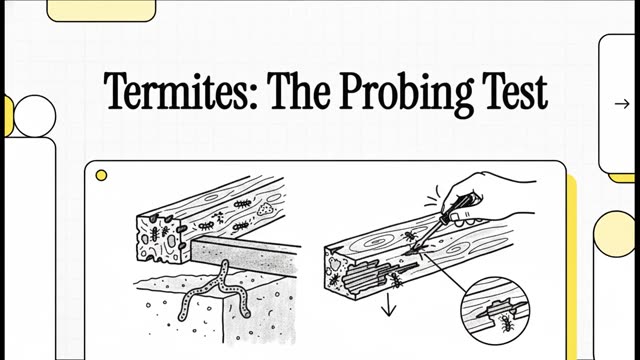
How the probe test works, and what each result means
Tap the plastic handle firmly against the joist or sill plate and listen, then push the metal tip into the wood and feel how far it travels. Sound framing rings sharply and stops the tip cold. A dull, hollow thud means material has been removed from the core. A tip that sinks with little resistance means the member has lost its section. Sample several joists in the same bay rather than one: decay and insect galleries are rarely uniform, and the contrast between a solid member and a soft one is the evidence you are looking for. Record date, location, and whether the wood is damp or carrying fungal growth — that record is what an engineer's report and a contractor's scope are built on.
| Feedback | What it indicates | Next step |
|---|---|---|
| Sharp ring, tip stops | Sound member at that location | Sample more joists; check beam ledges and sills |
| Dull hollow thud | Interior loss of section | Document and photograph; find the moisture source |
| Tip sinks, spongy feel | Active decay or insect damage | Treat as structural; engineer before pricing |
| Damp, stained or crumbly wood | Sustained moisture above the safe range for framing | Fix water first; repair follows |
Fort Collins is a moisture problem first
Colorado's termite pressure is far lower than the Gulf Coast's, and the honest local failure mode is decay driven by water that arrives in two seasons. The Colorado Geological Survey calls expansive or swelling soil the state's most significant geologic hazard and records that about 50% of Colorado soil has high or very high shrink-swell potential, expanding 10% or more by volume as it wets with pressures up to 30,000 pounds per square foot. The Nunn series, whose type location is in Larimer County, is a fine, smectitic clay loam with 35–50% clay described in the subsoil as firm, very sticky and very plastic. Winter supplies the second cycle: Larimer County's frost line is 30 inches, and the county explains that an unheated structure lets frost force move horizontally below the foundation, while a heated structure forces it upward and produces heave. Water that reaches framing above that footing in a crawl space feeds decay, and the EPA's position that the key to mold control is moisture control applies directly — indoor relative humidity should stay below 60%, ideally 30–50%.
| Evidence | Where to look | What it means |
|---|---|---|
| White or grey fungal growth | Joists, sills and subfloor above the dampest ground | Active decay; section is being lost |
| Water staining and tide marks | Crawl space walls and the top of the footing | Recurring wetting, not a one-off event |
| Efflorescence on concrete | Foundation walls below grade | Water moving through the wall and evaporating |
| Mud tubes or swarmers | Concrete walls, piers, crawl space access | Termites present; confirm with a licensed inspection |
| Soggy insulation | Under-floor batts that sag or stay wet | Insulation holding water against framing |
What the repair actually costs, and who pays
Costs track scope rather than the word on the label. A crack sealing job is small money; replacing framing and stabilising supports is not. What matters for a Fort Collins owner is who pays: pest damage — insects and rodents — is a standard homeowners exclusion, and long-term decay from repeated wetting generally falls under maintenance exclusions as well. In practice, decline caused by water is your cost, which is why the moisture work has to be part of the structural bid rather than an afterthought. Colorado also has no statewide general contractor licence; general contracting is licensed by cities and counties, and Fort Collins publishes contractor licence classes including residential-only classes ER, MM, D1 and D2, so licence class is something to verify locally rather than assume.
| Repair scope | Published range | Notes |
|---|---|---|
| Crack sealing only | $250–$800 | Cosmetic; does not restore a member's section |
| Crawl space repair, moisture and framing | $2,500–$12,000 | Usually the right scope where decay is found |
| Pier-and-beam framing repair | $2,000–$15,000 | Joist replacement and sistering |
| Settling and underpinning | $5,000–$25,000; piers $1,000–$3,000 each | Where movement accompanies decay |
The order of operations that actually resolves it
Fix the water, then the wood, then the protective layer. Start by correcting grade, downspouts and any subdrain so the crawl space stops receiving water; CSU Extension's homeowner instructions are concrete — keep plants at least 5 feet from the foundation, trees at least 15 feet, no sprinkler spray within 5 feet, and keep downspout extensions in place. Then have a licensed engineer evaluate the framing and supports, replace rotted posts and sister damaged joists to restore load capacity, and only then apply a ground vapour barrier or full encapsulation with dehumidification. Colorado's disclosure regime reinforces the documentation habit: sellers and brokers must disclose adverse material facts actually known to them, and structural issues are named among the examples in the Colorado Lawyer's treatment of the duty, so a documented repair is an asset while an undocumented one is a liability.
| Step | Action | Why here |
|---|---|---|
| 1 | Probe and document; find and stop the water source | Decay cannot be fixed while it stays wet |
| 2 | Licensed pest inspection if tubes or swarmers are present | Confirms whether insects are part of the cause |
| 3 | Engineer's evaluation of framing, supports and footings | Converts a symptom into a scope |
| 4 | Replace posts, sister joists, stabilise piers | Restores the load path |
| 5 | Vapour barrier or encapsulation with dehumidification | Protects repaired wood; re-check after winter |
The annual inspection calendar that keeps it from coming back
One probe test tells you the state of the wood today; a four-point calendar tells you whether anything is changing. In early spring, at snowmelt, check the grade still falls 6 inches in the first 10 feet, that downspout extensions survived the winter, and that no water is standing against the wall — the Larimer County frost line is 30 inches, so water reaching the soil band above the footing is what feeds both heave and decay. In mid-summer, during the dry cycle, re-probe the same joists and record any that went from ringing to hollow, and measure any new cracking, because shrinkage movement and decay often appear in the same season in this soil. In autumn, before the first hard freeze, check the crawl space for staining, soggy insulation and fungal growth while it is still dry enough to work in, and fix whatever you find before winter seals it in. In winter, watch for frost or drip on cold ducts, pipes and cable runs, which is condensation telling you the space is not dry. Then verify your moisture management: CSU Extension's rules are plants at least 5 feet out, trees at least 15 feet, and no sprinkler spray within 5 feet of the wall.
Planning only — have a licensed professional engineer evaluate your foundation. Larimer County requires engineer's letters on footings, foundation and perimeter drain to be available to the inspector, so the engineering step is built into a permitted repair.
Sources
- Colorado Geological Survey, Expansive Soil and Rock: https://coloradogeologicalsurvey.org/hazards/expansive-soil-rock/
- Larimer County Urban Area Street Standards, Chapter 5 — Soils Investigations: https://larimer.gov/sites/default/files/uploads/2021/ch05_-_soils_investigations_and_reports_0.pdf
- Colorado State University Extension, PlantTalk 1617 Expansive Soils: https://planttalk.colostate.edu/topics/soils-amendments-composting/1617-expansive-soils/
- The Colorado Lawyer, Disclosure of Adverse Material Facts and Latent Defects (July/August 2024): https://cl.cobar.org/features/disclosure-of-adverse-material-facts-and-latent-defects-in-real-estate-transactions/
- Texas Department of Insurance, Five things your home policy won't cover (pest exclusion pattern): https://www.tdi.texas.gov/tips/what-your-home-policy-wont-cover.html
- Utah State University Extension, Subterranean Termites factsheet: https://extension.usu.edu/planthealth/uppdl/files/factsheet/sub-termites09.pdf
- US EPA, A Brief Guide to Mold, Moisture and Your Home: https://www.epa.gov/mold/brief-guide-mold-moisture-and-your-home
- HomeAdvisor, Foundation Repair Cost (2026): https://www.homeadvisor.com/cost/foundations/repair-a-foundation/